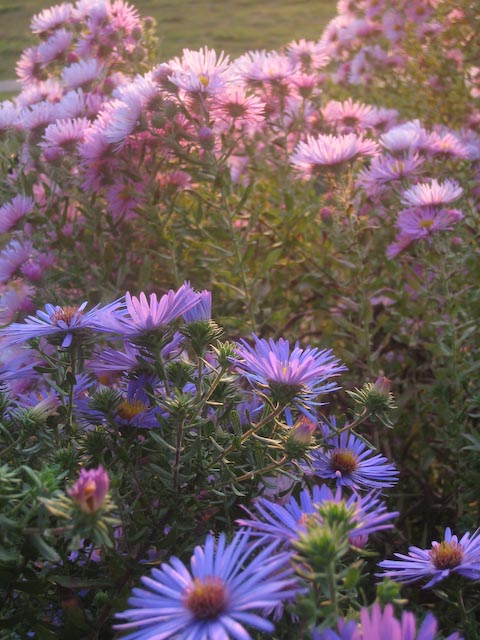
Asters (a huge and confusing family, that according to the molecular botanists should be split apart) are one of the stars of fall. The blues, pinks, wine-reds, and whites are all dusky. They are antique colors, not the saturated hues of summer. And even the modern hybrid crosses stubbornly refuse to be excessively extravagant and exotic looking.
The ones in this picture are descendants of the novi-belgii and novae-angliae group, the New York and New England native asters. Some of the other modern garden types are descedants of the Michaelmas Daisy (A. amellus), the European aster family. The North American group includes the prolific white wood aster, blue wood aster, heath aster, stiff aster and a myriad of others. All plants that go from dull green foliage to a profusion of white or blue flowers in September, usually without any care or feeding. Indeed, the white wood aster is more than capable of taking over any area. The New York and New England asters will grow in nearly any soil, from boggy to dry, though they don’t tolerate salt. They need some sun; ideally full sun, but are more than happy to grow on forest edge.
The aster is one of the plants where the North American species has as much, if not more, to recommend it when compared to its European cousin. It is a whole set of posts to ponder why the long preference for European or Asian flowers in North American gardens, and why in recent years that has changed.
The aster family is an excellent example of how modern science continues to debate and refine our understanding of the natural world: what was one genus has now been split into many, thanks to genetic studies. It is also a flower whose name evokes history. Aster is, of course, from the Greek. Michealmas recalls the old English calendars and hooks to whole symbology, from the naming of school terms to astronomy to Christianity, that lies behind that single word. Novi-belgii and novae-angliae serve as reminders of the complexity of the European settlement in North America, for the New York aster’s Latin name stakes the flag of Belgium.


I love the relationship between your photos and text. They add rather than define or limit. They often ask a question and always involve the reader. So thoughtful-the touch of the poet.